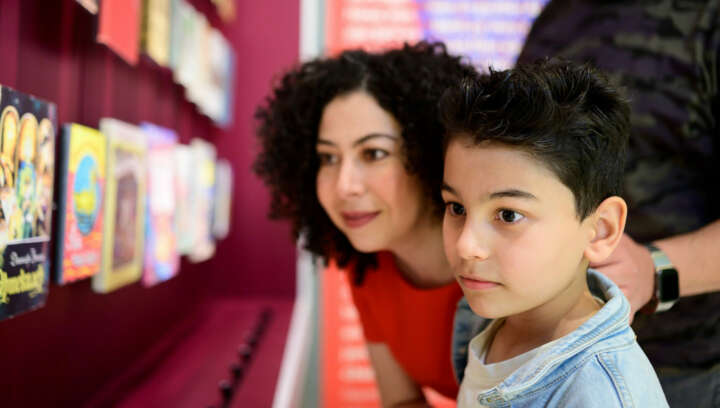
The GRIMMWELT in Kassel, the largest exhibition center dedicated to the Brothers Grimm and their Children’s and Household Tales, presents a comprehensive permanent exhibition on the life and work of the presumably best-known German linguists and fairy tale collectors.
The exhibition center has a special architecture reminiscent of a “fairy-tale castle” and has attracted over a million visitors since its opening in 2015. It is certainly worthwhile to make a trip to Kassel, which is located in the heart of Germany!
Can you recall one or the other of the characters from the Grimms’ Fairy Tales?
Markus Lefrançois, an illustrator living in Kassel, has portrayed some of the fairy tale characters in pictures, and we are glad to introduce them to you now in more detail.
“Croak, croak! Kiss me!”—those are words which the frog never actually spoke. But it dares to demand to be allowed to sleep in the princess’s bed. After all, it was the one who rescued her golden ball from the well. That is too much for her, and she cries furiously, “Now you’ll be quiet, you odious frog,” and throws it against the wall. But, as it falls down, the frog turns into a prince.
The bewitched Frog Prince comes from the magical fairy tale that the Grimms considered “one of the very oldest and most beautiful fairy tales”. This is already stated in the appendix to the 1812 edition of the Children’s and Household Tales. The fairy tale’s alternative title, Iron Henry, is hardly known today.
An old donkey is due to be slaughtered and decides to run away to Bremen to become a town musician there. On the way, the donkey meets an old dog and takes him along: “I’ll play the lute, and you’ll beat the drums.” The two then meet an old cat, who was also supposed to be killed by its mistress and now joins up with the others. Finally, an aging rooster makes the band of seniors complete. In the fairy tale, the four animals never actually make it to Bremen; instead, the group drives a gang of robbers out of their den and settles down in the house.
This fairy tale has very ancient literary sources; parts of its origins can be traced back as far as the 1st century B.C. Over the centuries, different variants have emerged—sometimes there is an ox rather than a dog, sometimes one of the animals is a goose; in some cases there is only a fox instead of the robbers, in others there are twelve wolves. It is the Grimm brothers’ version which first introduces the town of Bremen. The striking element is the fairy tale’s background theme: the ingratitude of people who want to rid themselves of their loyal animal servants once they are no longer useful.
Sleeping Beauty, one of the best-known fairy tales of the Brothers Grimm, was passed on to them by Marie Hassenpflug. Her Huguenot roots explain the similarities between her fairy tales and French narrative traditions. In Sleeping Beauty as well, there are definite traces of fairy tales from Charles Perrault’s collection Histoires ou Contes du temps passé. The Grimms themselves remarked on this in their notes to the Children’s and Household Tales. However, Perrault also drew on older sources; there are versions which can be traced back to the 14th century. Thus the Children’s and Household Tales are essentially international, combining North Hessian originals with Greek narrative structures, Scottish tales, and French traditions.
Little Red Riding Hood goes into the woods, disregards her mother’s warnings, and is subsequently eaten by the big bad wolf. But the huntsman manages to save her, and the wolf receives its just punishment: death. Order is restored, and Little Red Riding Hood has learned her lesson. When she encounters a wicked wolf on a later occasion, she is able to trick it into drowning.
What is hardly recognizable in the versions known today, is that the tale is not necessarily about wolves. For the Grimm brothers and their contributors broadly desexualized the Children’s and Household Tales. In older versions, for example, Little Red Riding Hood even lies down naked in bed with the wolf. The Grimms’ version does not go so far; the wolf jumps out of bed and devours her right away. The Grimms retain their moral tone, but Red Riding Hood’s misdeed is rewritten.
“Soon after that she had a little daughter, who was as white as snow, and as red as blood, and her hair was as black as ebony, and she was therefore called Snow White.” This story has everything one would expect from a fairy tale: a wicked witch as stepmother, a beautiful princess, dwarfs, and the rescuing prince; riddles and magic; a happy ending; and an evil doom for the wicked stepmother: “Then she was forced to put on the red-hot shoes, and dance until she dropped down dead.”
It is clear that here “good” qualities are rewarded and “evil” ones punished; good must triumph in the end. Snow White is pure and virtuous; that is why the kiss that frees her at the end does not take place in the Children’s and Household Tales. On the contrary, the poisoned apple is loosened when the dwarfs happen to stumble while carrying the coffin.
Markus Lefrançois grew up in the lovely town of Seligenstadt. He completed his studies at the Kassel Art Academy as a master student, specializing in illustration and graphic design.
He has been working as a freelance designer since 2004. In 2007, he founded the publishing house rotopolpress in Kassel together with colleagues. For many years, he was a lecturer at the Kassel Art Academy and the European Art Academy in Trier, and he conducts workshops throughout Germany. Since 2021, he has belonged to the jury of the prestigious Oldenburg Children’s and Young Adult Book Award. Since 2026, he has been a jury member of the German Nominating Body for the world-renowned Astrid Lindgren Memorial Award.
He is known in particular for his fairy tale illustrations, which is why he and the GRIMMWELT cooperate closely. His works have frequently been shown in temporary exhibitions, such as the current one “RESHAPING TALES | HELGA GEBERT”, and also feature in the permanent exhibition.